
Run Multiple AI Coding Agents Without Losing Control
Running two or three AI coding agents in parallel is cheap. The real limit is review capacity, not execution capacity - diffs pile up faster than you can read them. Treat parallel agent work as a five-step loop (Decompose, Isolate, Execute, Review, Integrate) and size the number of agents to the number of concurrent reviews you can actually hold.
You can run two or three AI coding agents in parallel today - Claude Code in one terminal, Codex in another, Cursor's agent in a third, maybe a provider subagent on top. Each one is cheap to start, and the first few runs feel like free throughput.
Then the pile-up starts: three agents all finishing at once, each producing a diff that touches a different corner of the same repo. Which do you read first? Which do you merge? Which do you throw away?
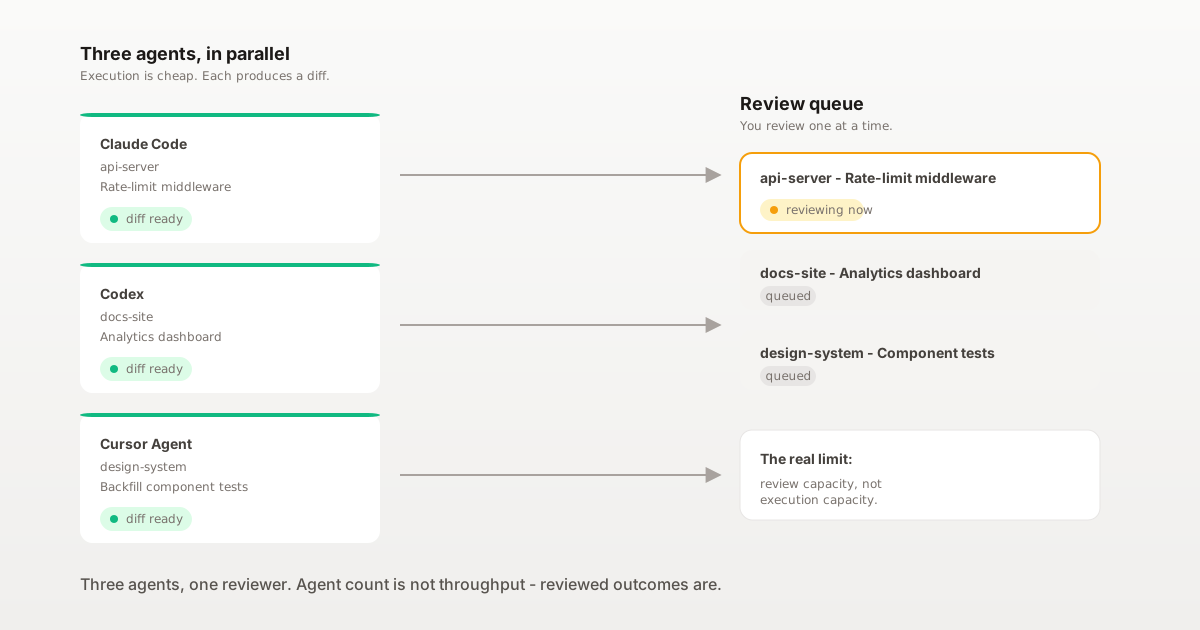
Key idea: agent count is not the productivity metric. Completed, reviewed outcomes are.
Why does running more agents stop working?
Adding an agent adds two things: an execution unit and a review item. Both have cost.
The execution cost is familiar: tokens, time, machine resources, your attention to prompts. That is usually not the bottleneck.
The review cost is the one that catches people out. Every agent run eventually produces a diff you have to read, test and integrate. If agents produce diffs faster than you can review them, a hidden review queue grows. Changes stall waiting for your eyes. You start merging under pressure, which is where the real bugs come in.
agent executes a task      ← cheap, parallelizable
you review the diff        ← expensive, mostly serial
you integrate the change   ← serial per branch
The real concurrency limit is set by whichever of those three is slowest. For most people, that is review.
What is a practical model for running agents in parallel?
Think of parallel agent work as a five-step loop you run per task. The parallelism lives in Execute. Everything else stays small on purpose.
1. Decompose
Split the work into independent outcomes before you start any agent. "Independent" means each task could be shipped on its own without the others.
Good decompositions:
A: Add a rate-limit middleware (no behavior change elsewhere)
B: Build an analytics dashboard page (new route, no shared model)
C: Backfill tests for an existing public API (read-only)
Bad decompositions - the kind that look parallel but are not:
A: Redesign the user model
B: Rewrite every API that depends on the user model
C: Migrate the database tables for the user model
Those tasks are coupled by schema. Running them in parallel does not save time; it just surfaces the conflicts later.
2. Isolate
Give each independent task a boundary it can edit without stepping on the others.
- Separate repository. The strongest isolation; use it when the task truly belongs elsewhere.
- Git worktree. For independent changes inside the same repository. Each agent sees its own working tree.
- Separate branch in a shared checkout. Weaker - two agents in one working tree can clobber each other even on different branches. Prefer worktrees when agents run concurrently.
- Different providers. Claude Code on A, Codex on B, Cursor on C is a form of isolation too; keep each diff in an isolated branch.
3. Execute
Start the agents. For each one, write the prompt as a reviewable outcome, not an open-ended invitation:
Outcome
Scope
Constraints
Definition of done
Verification
Example:
Outcome:
Add a /healthz endpoint that returns 200 and a short JSON body.

Scope: handlers.go, routes.go.
Constraints: no change to auth middleware.
Definition of done:
- endpoint returns 200
- existing tests pass
- new test covers the body shape
Verification: `go test ./...`.
Agents that have a clear definition of done produce diffs you can accept or reject in one pass.
4. Review
The step that gates everything else. Cap the number of concurrent reviews, not the number of agents.
A practical cap: one active review at a time, with a short queue behind it. If the queue is growing faster than you clear it, stop starting new agents.
A review has to cover more than "does the code look right?":
tests pass
diff makes sense in isolation
no accidental cross-cutting changes
no secrets, no logs with real data
dependency and version changes called out
The faster the agent, the more important this layer becomes.
5. Integrate
Merge reviewed diffs one at a time. Resolve conflicts deliberately rather than letting Git auto-merge changes an agent wrote.
If two reviewed diffs touch overlapping areas, treat the second one as needing a quick re-review after the first merges. Remove worktrees and clean up temporary branches after integration.
Rule: parallelize independent outcomes, not independent prompts.
When does the model fail?
The loop only holds while tasks are actually independent. A few failure patterns:
| Pattern | What goes wrong | Fix |
|---|---|---|
| Shared schema | Two agents refactor the same type in different ways | Keep schema changes in one task; downstream agents consume after merge |
| Shared config file | Both agents rewrite package.json with different additions | One agent owns dependency changes per cycle |
| Generated artifacts | Both agents regenerate the same build output | Run generation after merges, not per agent |
| Shared tests | One agent "fixes" a test the other agent still needs red | Lock test ownership to the agent whose work it validates |
| Review backlog | Agents finish faster than you review | Reduce concurrency, not provider or model |
If you keep hitting the first four, your decomposition was wrong. If you hit the fifth, you were running the wrong number of agents.
What native options already exist?
Before adding a tool, check what the ecosystem already gives you.
- Git worktrees - the native isolation layer for independent changes in one repository.
- Provider subagents - Claude Code and some other providers can spawn subagents inside one session. Useful for decomposition inside a plan, less useful for truly parallel work.
- Terminal multiplexers (tmux, screen) - keep each agent in a named pane and label the pane with the task.
- Dedicated review tools - a terminal diff viewer, your editor's diff pane, or a short-lived branch opened in a PR. Pick one and use it for everything.
These give you decomposition, isolation, execution and some of integration. Visibility across them - whose agent is waiting, whose is done - is where things get thin.
Where does SwitchStation fit?
SwitchStation by SSS Flow focuses on the visibility problem across agents and across projects.
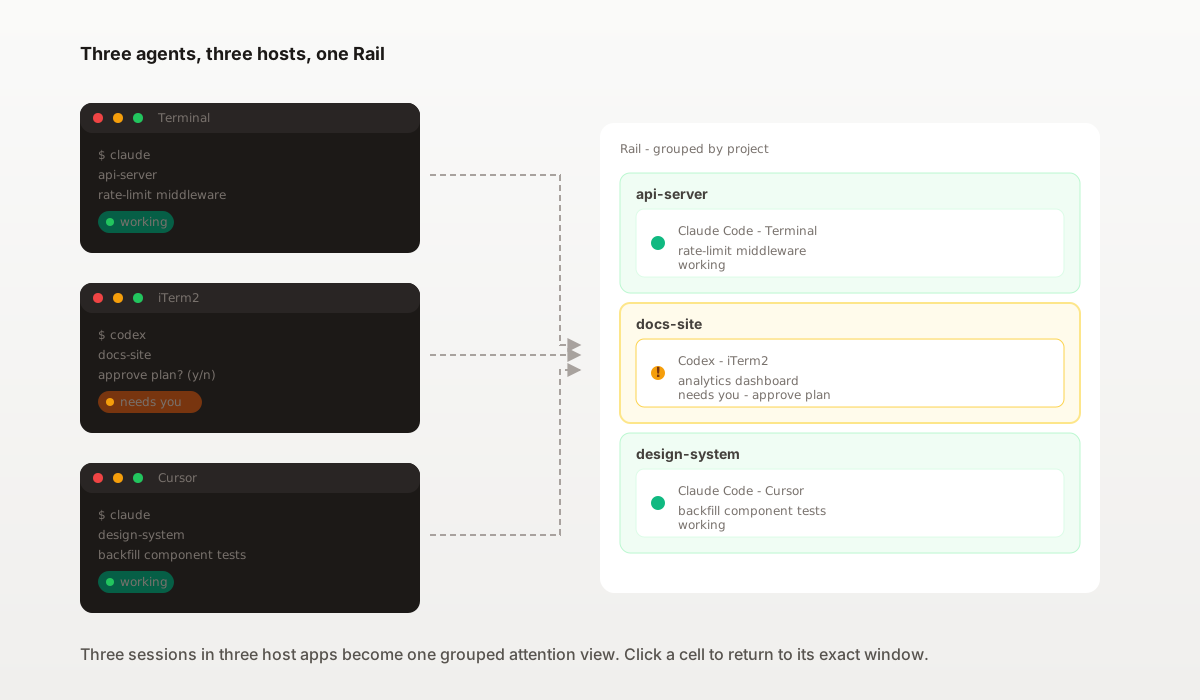
Rail - a thin vertical strip on the right of your main screen that shows every detected Claude Code and OpenAI Codex CLI session grouped by project. Three states: working, waiting for you, idle. One click brings back the exact window.
Workspace - a project home with a built-in terminal deck. Useful when a single project runs several agents at once and you want them all inside one window with files and previews next to them.
Both are local-only. Rail Core and the hook bridge do not send network traffic, do not log prompts or responses, and do not read source code.
Boundary
SwitchStation is not an autonomous orchestrator. It does not decompose tasks for you, does not run the agents, does not review the diffs, and does not integrate the changes. The five-step loop above is still your job - SwitchStation only tells you where in that loop each session currently sits.
Which starting point matches today's pain?
| Current pain | Start with |
|---|---|
| Agents stepping on each other's files | Git worktrees + one agent per worktree |
| Prompts that keep producing ambiguous diffs | Rewrite each prompt with a definition of done |
| Backlog of unreviewed diffs | Reduce concurrency; add a review cap |
| Not sure which agent finished | A notification hook on Stop |
| Several agents across projects / tools | A cross-tool attention layer like Rail |
| One project with heavy agent use | A dedicated project window like Workspace |
What is the mental model to keep?
agent count       ≠ throughput
agent concurrency ≠ outcome concurrency
execution speed   ≠ delivery speed
The useful metric is reviewed outcomes per week. Anything else - number of agents, tokens burned, model mix - is a resource chart, not a result chart.
What should you do next?
Start by naming the review cap you can actually hold today - probably one or two concurrent reviews. Then size the number of agents to match.
If today's pain is losing track of which agent needs you, read Claude Code Notifications: Know When a Session Is Done. If you want a single surface for every detected session across projects and tools, see how SwitchStation Rail works.
Then read:
- Run Multiple Claude Code Sessions Without Losing Track
- How to Manage Multiple AI Coding Projects on a Mac
FAQ
How many AI coding agents can one person run at the same time?
Not a fixed number. The ceiling is set by review capacity, not model throughput. Most people hold one or two concurrent reviews before quality drops. Size the number of agents to that number plus a small queue.
Should I run several agents on the same task?
Only when you can review and compare the outputs. "Two agents racing on the same prompt" wastes review time unless you intend to pick the better diff and discard the other.
Does more parallelism always help?
No. Past the review limit, parallelism increases rework rather than output. Watch the review queue, not the agent count.